
Where Viral Products Actually Come From
The thing you saw on your feed this morning has a longer biography than you would guess.
It did not appear because someone had an idea last week. By the time it reaches an Indian phone screen, it has usually passed through a factory, a wholesale market, an exporter, a container ship, a customs clearance, an importer, a seller, an ad account, and a courier. Each of those is a business with its own margin, and each one is the reason the product costs what it costs.
Most shops would rather you didn't think about this. We think it makes the whole category more interesting, and a lot easier to shop well.
It starts with a cluster, not a factory
Small-goods manufacturing anywhere in the world is not spread evenly. It clumps.
You can see it at home. Tiruppur makes knitwear, and has done for decades, with spinners, dyers, printers and stitching units packed into the same few square kilometres. Moradabad makes brassware. Rajkot makes small engineering goods and castings. Nobody planned these places into existence. They formed because one workshop succeeded, a second opened next door to supply it, and forty years later there is an entire ecosystem of skills, suppliers and machinery that a newcomer somewhere else simply cannot assemble.
The same pattern repeats across the world wherever consumer goods are made in volume. Bac Ninh in northern Vietnam has become a dense electronics assembly belt. Hsinchu in Taiwan built decades of precision electronics capability into a few districts. Denizli in Turkey is a home textiles town in the way that Tiruppur is a knitwear town.
The clustering is the reason these products can be cheap. If you want to change the colour of a housing, the moulder is a ten minute drive away. If you want a different battery, there are forty suppliers within the same district. A change that would take weeks somewhere else takes an afternoon, and a factory that can iterate in an afternoon can afford to try things.
This is also why trends move so fast. When one product sells, a dozen nearby factories can be making a version of it inside a month. That is not piracy exactly, it is how clusters have always worked, and it is why almost no viral product stays exclusive for long.
Nobody in the chain invented it
Here is the part that surprises people most. The product you saw usually has no single author.
A factory makes a variation on something that was already selling. A trading company puts it in a catalogue. A video creator somewhere finds it and shoots fifteen seconds that make it look magical. That video does numbers, and suddenly every seller in every market wants the thing, including sellers in countries the factory has never shipped to.
So the "brand" on a viral product is often just whoever printed the box. That is not automatically a bad thing, plenty of genuinely good objects are made this way, but it does mean you should not read a brand name on a viral gadget as a promise about quality. It is a label, not a track record.
The journey to India
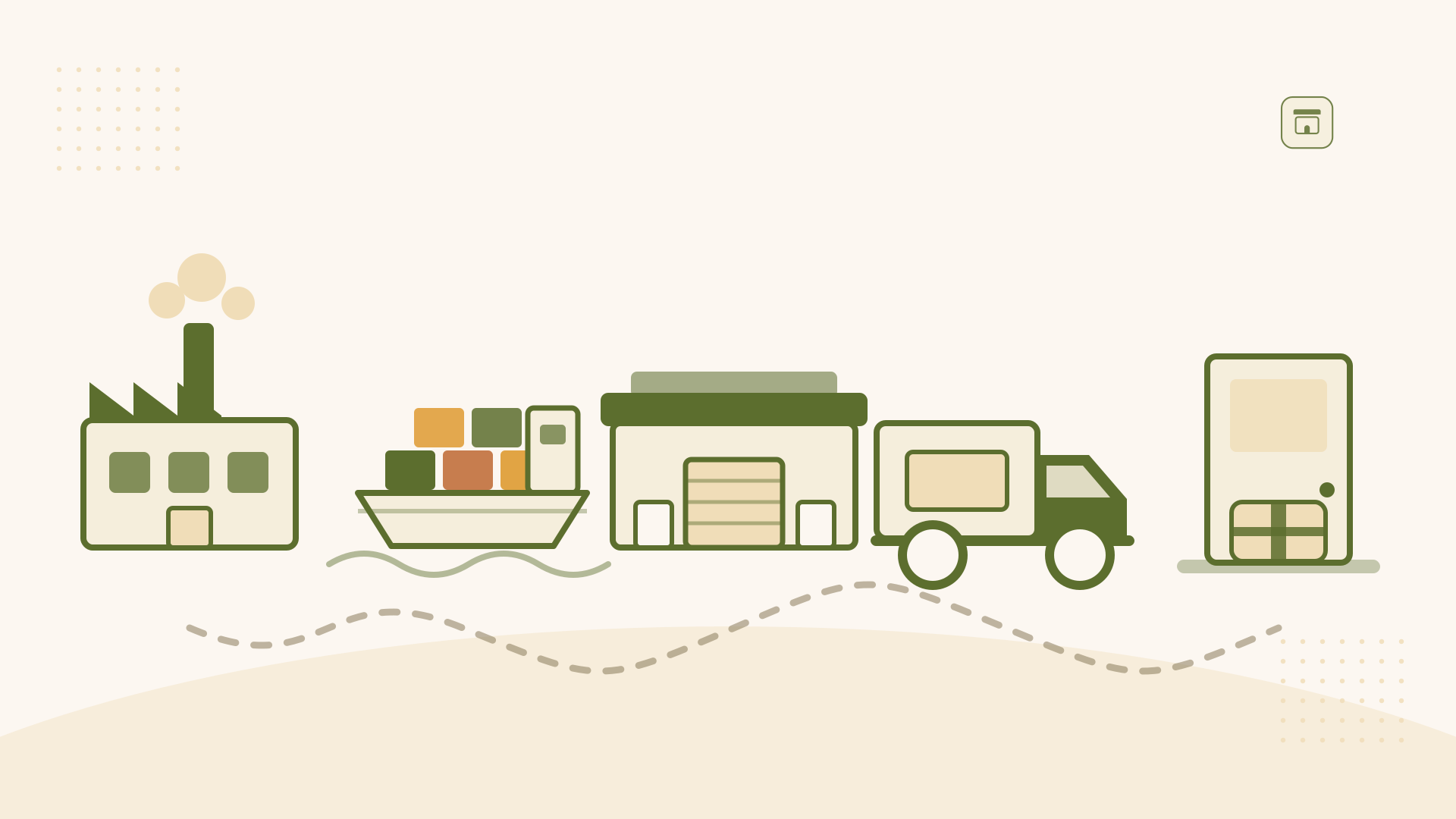
From the factory, a typical route looks like this.
The goods go to an exporter or trading company that consolidates orders from several buyers into one shipment. That shipment goes by sea, because air freight destroys the economics of anything cheap. A sea crossing to an Indian port takes a couple of weeks in good conditions, and considerably more when it doesn't.
Then customs. Then the importer's warehouse. Then, usually, one or two more hands: a distributor who breaks the shipment into smaller lots, and a seller who buys those lots.
By the time the product is sitting in an Indian warehouse, it is often three to four months from the moment the factory ran it. Which means something worth knowing: when you see a product go viral in India, the stock was ordered long before the trend peaked, by someone who was guessing.
That guess is the actual business. Everything downstream, the ads, the photos, the landing page, is just a consequence of whether somebody guessed right about a product months ago.
Why this matters when you are shopping
Three practical things follow from all of it.
Price differences within the same product are often real. Two sellers listing what looks like the identical gadget may be selling genuinely different versions, because a cluster produces the same shape at four different quality grades. A thinner housing, a smaller battery, a cheaper motor. The photo is identical because it came from the same catalogue. The object is not.
"Sold out" often means the trend is ending, not peaking. Because of the lead time, sellers stop reordering long before the demand disappears. If something is suddenly hard to find, the guess upstream has already moved on.
The seller is the only variable you can actually judge. You cannot inspect the factory. You cannot audit the exporter. What you can look at is whether the shop selling it will answer a message, whether they describe the product in their own words or paste the supplier's, and what happens if the thing arrives broken.
Where we sit in this
We will be straightforward about our own position. We do not own a factory and we do not manufacture anything. We buy from contacts who import directly, which means we sit closer to the source than a reseller buying off a domestic marketplace, and much further from it than the people who made the thing.
What we control is the last few links: which products we take, whether we have actually used them, how they are repacked for Indian logistics, and how we behave when something goes wrong. That is a smaller claim than most stores make. It is also the one we can actually keep.
The next time something lands on your feed and you feel the pull to buy it in the next twenty seconds, it is worth remembering how long that object has been travelling to get in front of you. It waited months. It can wait ten minutes while you look at who is selling it.
Street Bazaaar stocks trending products for delivery across India, prepaid, packed and dispatched by us.